Wayfauna

A walking game for iPhone

A field guide you fill in by walking.

Wayfauna turns everyday walks into fieldwork. Real species turn up where they actually live, field stations dot the parks, and chrysalises emerge from your branch as you walk. Your notebook fills in with the seasons.

Coming soon to the App Store
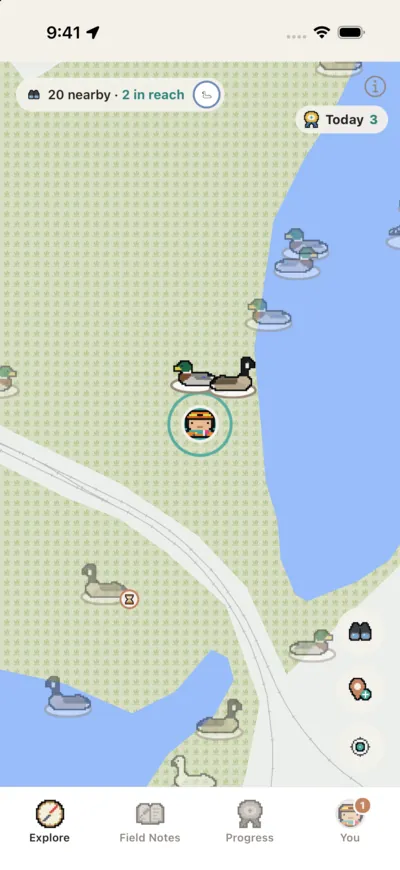
The Wayfauna map in a park: your explorer by a pond, with mallards and Canada geese nearby, 20 creatures around and 2 in reach

A walk in six screens

Real screens from the app, in Edmonton’s parks.

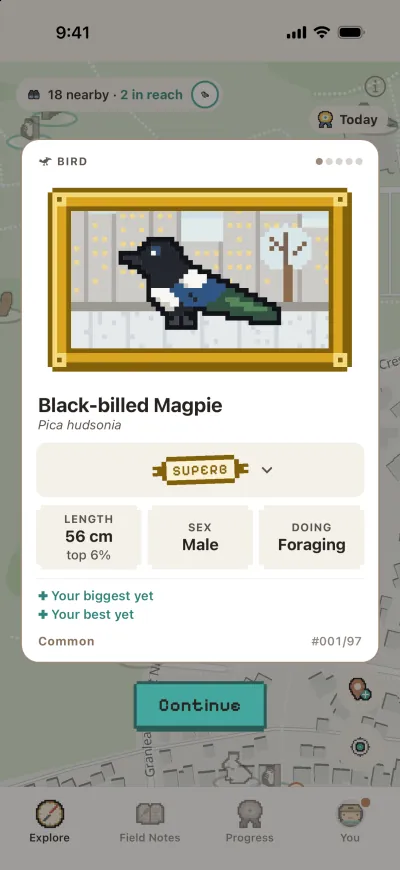
  1. A black-billed magpie just spotted, over the map: its picture in a gold frame stamped Superb, a 56 cm male in the top 6% for length, foraging, marked your biggest yet and your best yet
    01Spot itWalk up to a creature on the map and spot it. Each one is an individual, with its own size, sex and behaviour, and a grade on its frame.
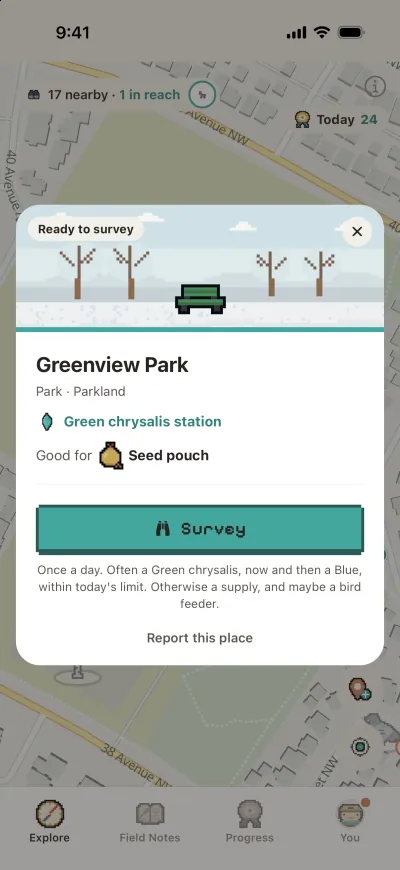
  2. The card for Greenview Park, a Green chrysalis field station, ready to survey, with its Survey button and what a survey can bring
    02Survey a field stationParks, trees, rinks, goals and lookouts are field stations. Survey one once a day. A Green station often gives a Green chrysalis, now and then a Blue; otherwise a supply, and maybe a bird feeder.
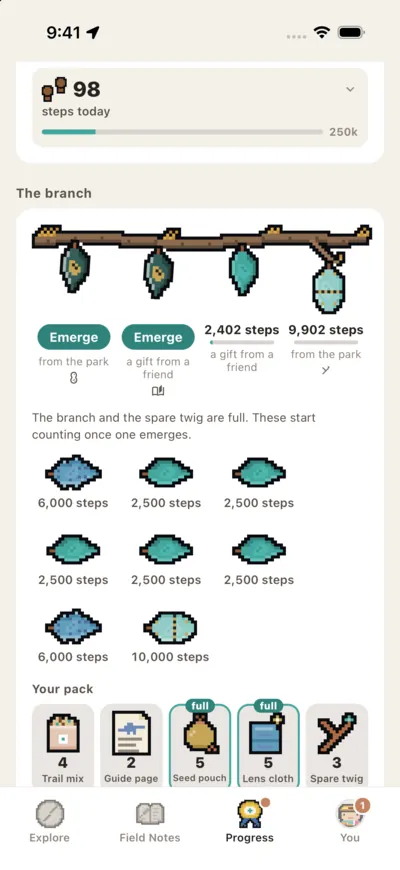
  3. The branch with four chrysalises, two ready to emerge and two still counting steps, above the pack of field supplies
    03Hang it on the branchChrysalises wait on the branch while you walk. When the steps add up, each one is ready to emerge.
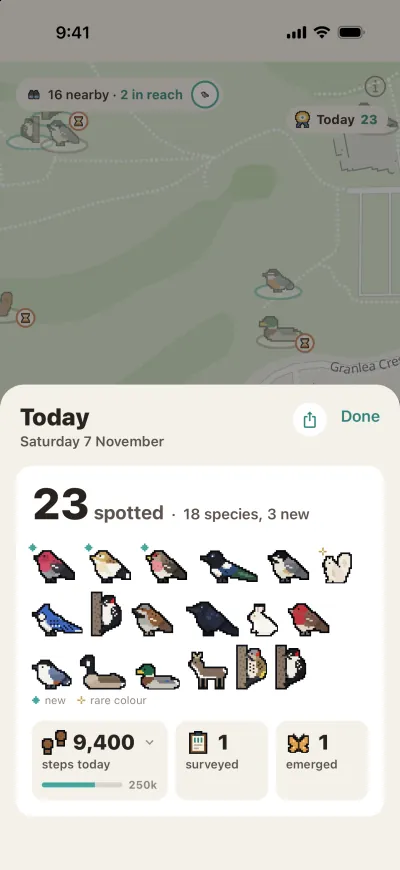
  4. The Today sheet over the map for Saturday 7 November: 23 spotted across 18 species, 3 new, each species drawn in three rows with the new ones and a rare colour marked, then 9,400 steps, 1 surveyed and 1 emerged
    04See your dayToday sums it up on one short sheet: every species you spotted, with the new ones and rare colours marked, then your steps, your surveys and what emerged.
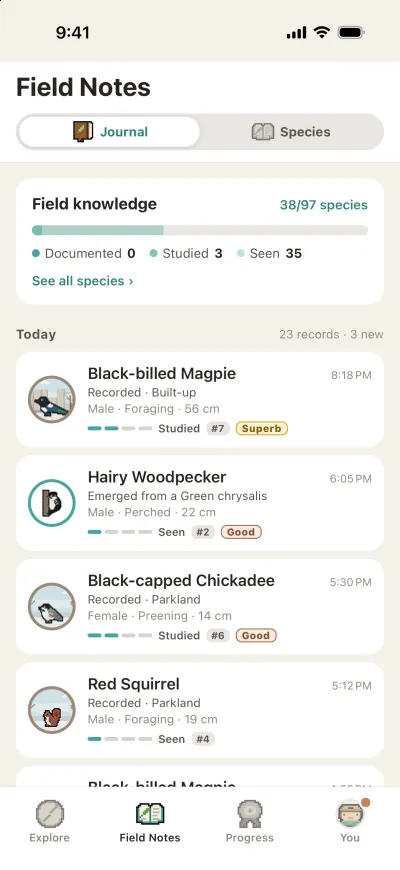
  5. The field notes journal: field knowledge at 38 of 97 species, and today’s 23 records, 3 new, led by a black-billed magpie graded Superb, a hairy woodpecker emerged from a Green chrysalis graded Good and a black-capped chickadee graded Good
    05Fill your field notesEvery record goes in your field notes with its grade, and each species climbs from Seen to Studied as you find more.
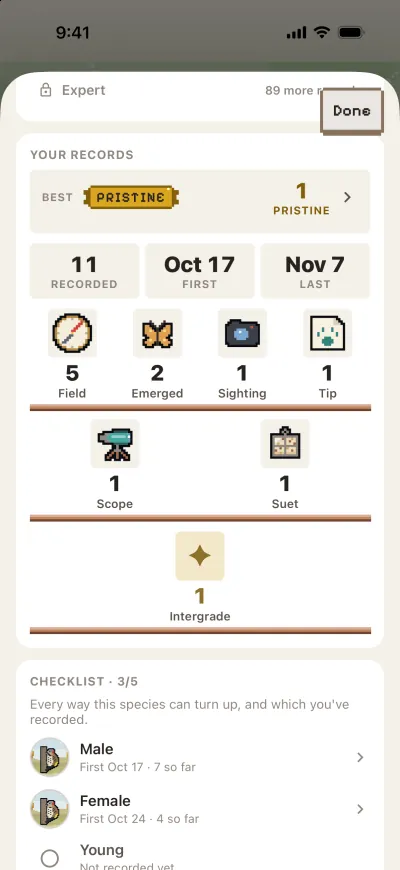
  6. A northern flicker’s species page at Your records: best grade Pristine, with 1 Pristine; 11 recorded, first on Oct 17 and last on Nov 7; found 5 in the field, 2 emerged, 1 sighting, 1 tip, 1 with a scope and 1 at suet; and 1 intergrade, a rare colour
    06Keep your bestEach species keeps your records: your best grade, Pristine the rarest of all, how many you’ve recorded, how you found each one, and any rare colours.

How it plays

01

Find what lives here

What turns up depends on the ground under your feet: chickadees in the woods, mallards on the pond, swallowtails in a summer meadow, owls after dark. Every species is one found in the Edmonton area, each in its season.

Black-capped chickadeeMallardCanadian tiger swallowtailRed squirrelWild rosePileated woodpecker

02

Survey field stations

Lookouts, springs, bird hides and parks, and the soccer goals, ball diamonds, rinks and courts in your neighbourhood park: 1,706 of them across Edmonton. Survey each one once a day for a chance of a chrysalis, which can come up a grade, and of a field supply.

Bird hideViewpointWaterfallSpringTrailheadSoccer goalBaseball diamondOutdoor rinkTennis courtDisc golf basket

03

Chrysalises emerge as you walk

They hang on your branch and emerge once you’ve walked enough, counted from your phone’s step count even with the app closed. The longer the walk, the better the odds of something rare. Field supplies tip things your way: trail mix for a shorter walk, a guide page to see what’s inside, a lens cloth for a better shot at a rare colour.

Green chrysalis2,500 steps
Blue chrysalis6,000 steps
Gold chrysalis10,000 steps

Gold gives the best odds of the rarest species.

04

Fill your field notes

Each species goes from Seen to Studied to Documented to Expert, and a hundred records earns its gold badge. Every step unlocks something new about it: an identification tip first, then field facts, and a rare one for experts. Every creature you spot is an individual, with its own size, sex, life stage and behaviour, so the twelfth robin is still worth a look. Rare colours, like a leucistic mallard, turn up now and then, and they’re worth the hunt.

Blue jay
Blue jay
Leucistic blue jay
✦ Leucistic
Great horned owl
Great horned owl
Pale subarctic great horned owl
✦ Pale subarctic

05

Dress your explorer

Your explorer wears what you’ve done: a toque for a winter survey, waders for mastering the wetland, a headlamp for finding all five owls, a naturalist’s beret for reaching Expert on a species. Almost everything you do also earns a little experience toward your Naturalist level, and the levels bring chrysalises and four more pieces, up to a warden’s coat at level 40. Complete an outfit set for a title, a pin and a Gold chrysalis. There are 49 pieces to earn, and none of them are for sale.

Explorer in the starting field kitExplorer in a toque and parkaExplorer in a sun hat, rain shell and waders, holding binocularsExplorer in a headlamp cap and night jacket, holding a lanternExplorer in a court visor, running vest and disc golf shorts

06

Walk with friends

Add friends with a code. Compare field notes, see who’s been out today, and keep a shared streak going on the days you both get outside. Friends see what you’ve found, never where.

A friend's explorer holding a butterfly net upright
12
days together
Your explorer

The rarest five

Some species almost never turn up in the wild, and a Gold chrysalis is the surest way to meet them.

Great gray owl
Great gray owl
Snowy owl
Snowy owl
Northern hawk owl
Northern hawk owl
Moose
Moose
River otter
River otter

Private by design

Wayfauna never keeps a trail of where you've walked. It stores the places you choose to record, and step totals from your phone. Friends see what you've found, never where. No ads, no tracking. Read the privacy policy.

Questions

Where can I play?
Wildlife and field stations are mapped for Edmonton so far. The game works anywhere, but outside Edmonton there’s not much to find yet.
What does it cost?
Nothing. There are no ads and nothing to buy.
What do I need?
An iPhone. Your steps come from the phone’s own step counter, so there’s nothing to wear.
What about my location?
Wayfauna never keeps a trail of where you walk. Field stations stay off school grounds and away from houses, and every place a player suggests is checked by a person before it goes on anyone’s map.
Coming soon to the App Store